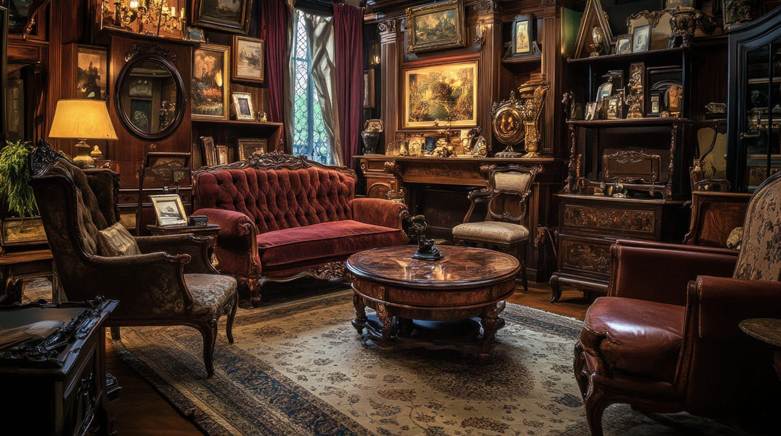
A single antique can entirely change the character of a modern room. Chanel Postrel shows how contrast between old and new can create depth without turning an interior into a period recreation.
Placed beside a contemporary sofa or clean-lined table, an antique immediately becomes more distinctive. Its craftsmanship, patina, and history stand apart from the restrained forms around it, while the modern pieces gain warmth through that contrast. Instead of filling a room with furniture from one era, a carefully chosen older piece can introduce individuality without overwhelming the overall design.
A Single Antique Has Room to Be Noticed
Antiques frequently contain details that attract attention naturally.
Hand-carved wood, aged brass, unusual proportions, decorative inlay, worn leather, and surfaces developed over decades can give an older piece substantial visual presence.
When many highly detailed antiques occupy the same room, those qualities can begin competing with one another. A carved chest sits beside an ornate table, which faces an elaborate cabinet, while several smaller historical objects occupy every available surface.
Each piece may be compelling independently, yet the room can make it difficult to appreciate any one of them.
Using a single significant antique alters that relationship.
Against simpler surroundings, its silhouette and craftsmanship become easier to see.
Contrast Can Make History Feel More Relevant
One reason an antique can work particularly well in a modern interior is that it does not disappear into its surroundings.
Imagine a dark 18th-century-inspired chest placed beneath contemporary artwork and beside a clean-lined chair. The differences are obvious, but that is precisely what makes the composition compelling.
The antique does not need to pretend it is modern.
Likewise, the contemporary furniture does not need decorative details added merely to make it coordinate with the older piece.
Contrast allows each era to retain its identity.
This approach can prevent historically influenced design from becoming a literal period recreation. The room acknowledges the past without attempting to live entirely within it.
Choose Character Rather Than Age Alone
An object does not automatically deserve a prominent place in a room simply because it is old.
Age is only one characteristic.
When choosing an antique for a contemporary interior, the more useful questions concern what the piece contributes visually and functionally.
Consider:
- Does the silhouette add something distinctive?
- Is the scale appropriate for the room?
- Does the material complement or contrast effectively with surrounding finishes?
- Is the craftsmanship worth highlighting?
- Can the piece perform a useful function?
- Does it have enough character to stand independently?
An antique selected according to these qualities can feel intentional rather than inserted merely to make the room appear historically informed.
Patina Introduces Something New Furniture Cannot Immediately Have
One of the most distinctive characteristics of antiques is patina.
Wood changes with age. Metals oxidize. Leather develops variations in tone. Small scratches and signs of use become part of an object’s surface.
These characteristics can be especially effective in highly polished contemporary spaces.
New construction and modern furniture frequently emphasize smooth finishes, precise edges, and consistent surfaces. Introducing one object showing evidence of age can interrupt that perfection in a useful way.
The contrast can make the room feel less like everything arrived simultaneously.
Patina should not be confused with neglect. An antique can be well maintained while still displaying evidence of its history.
Those imperfections are often part of what gives the piece individuality.
Let Modern Furniture Remain Quiet
Once a significant antique is introduced, surrounding furniture does not necessarily need to compete for attention.
A restrained sofa, simple side chair, or contemporary lamp can provide a quieter backdrop.
This does not mean modern furniture must be plain or anonymous. It means each piece can have a different role.
The antique may provide historical character. Upholstery may establish comfort and color. Lighting may introduce sculptural interest without becoming another highly ornamented focal point.
Allowing furniture to perform different visual jobs creates a more nuanced room than asking every object to make an equally strong statement.
Scale Matters More Than the Number of Antiques
One well-scaled piece can influence an entire room.
An antique secretary, cabinet, chest, mirror, or substantial table may carry enough visual presence that additional historical furniture is unnecessary.
Smaller rooms particularly benefit from this restraint.
Trying to introduce several dark or heavily detailed antiques into limited space can make the room feel visually dense. One carefully positioned piece can establish the historical reference without consuming the composition.
Larger rooms may accommodate several antiques, but even there, spacing matters.
Giving distinctive pieces enough room allows their forms to register individually.
An Antique Can Still Be Functional
Living with antiques does not require turning a home into an exhibition.
Many older pieces were created for practical use, and they can continue performing useful roles in contemporary homes.
A chest can provide storage. A writing desk can become an occasional workspace. A side table can hold a lamp. An antique dining table may remain central to everyday meals.
Function can actually help an antique feel more integrated.
When a piece participates in daily life, it becomes part of the room rather than an object positioned solely for observation.
The key is respecting the condition and limitations of individual pieces rather than assuming every antique should be used identically to new furniture.
Do Not Force Everything Else to Match
After introducing an antique, homeowners sometimes feel pressure to repeat its characteristics throughout the room.
A dark wooden chest leads to dark wooden side tables. Traditional hardware appears on new cabinetry. Ornate frames and historically inspired lighting are added to reinforce the theme.
Soon, one antique has determined every other choice.
That can weaken what originally made it interesting.
A room does not need several imitations of an antique to make the original piece belong. Connections can be much subtler.
A color in the wood might reappear in a textile. Brass hardware could relate loosely to a contemporary light fixture. Artwork may provide a visual bridge between traditional and modern elements.
Connection does not require duplication.
Negative Space Makes Character More Visible
An antique with intricate details benefits from breathing room.
Placing numerous accessories on top of it or surrounding it with heavily patterned objects can obscure the qualities that made the piece worth choosing.
Negative space can provide contrast.
A relatively bare wall may make an antique mirror more dramatic. A chest with only one or two objects on its surface allows the wood and hardware to remain visible.
Restraint is particularly useful when the antique itself already carries substantial visual information.
Sometimes the best way to emphasize an interesting object is simply to stop adding things around it.
One Piece Can Set the Tone Without Setting a Theme
There is an important difference between giving a room character and giving it a theme.
A single antique can introduce history, craftsmanship, and permanence without requiring the rest of the interior to follow a specific historical style.
That flexibility is valuable in homes where tastes evolve.
Contemporary upholstery can change. Artwork can move. Lighting can be updated. Yet a well-chosen antique may remain relevant through several versions of the room.
Its ability to coexist with change can make it more versatile than expected.
Final Thoughts
Creating a historically informed interior does not require filling a room with antiques.
Sometimes one distinctive piece is enough.
An antique chest beside contemporary furniture, an aged mirror above a restrained console, or a traditional desk within a modern room can create a stronger dialogue between periods than an entire matching collection.
The effectiveness comes from contrast, scale, craftsmanship, patina, and careful placement.
When you give an antique enough room to stand on its own, its history becomes more visible rather than less. Modern surroundings do not diminish that character. Often, they make it easier to appreciate.
The result is a room that acknowledges the past without becoming trapped in it, a space where one object with history can provide precisely the amount of character a contemporary interior needs.